

What Should Be Protected When Marketing Budgets Tighten?

What Should Be Protected When Marketing Budgets Tighten?
I've spent over a decade hearing "How do we increase leases while tightening the monthly marketing budget?"
For any marketing leader, you need a methodology to turn to when it is time to ensure the marketing you are doing is truly driving performance, not just throwing money into the wind. This is where I decided that, instead of blindly cutting line items and pausing campaigns, I would define the three non‑negotiables in performance‑driven multifamily marketing that hold tight to the initial marketing strategy.
Protecting an asset in a constrained environment is about spending intentionally. It’s about knowing which levers drive leasing velocity, which channels deliver high‑quality leads, and which investments protect rent integrity. Everything else is noise.
Here are the three things that I keep protected when budgets tighten, and why discipline becomes the strategy.
Protect The Performance Levers
When absorption is on the line, the only dollars that deserve protection are the ones that directly influence leasing velocity, lead quality, and rent integrity. These are the channels that convert, not the ones that inflate traffic or make the dashboard look busy.
Performance levers include:
High‑intent digital channels that consistently produce qualified leads
Retargeting pathways that keep prospects moving toward conversion
ILS placements with proven ROI
Creative and landing page assets that shape renter perception
Attribution clarity that tells us what’s actually working
These are the non‑negotiables. They stay funded because they protect the asset’s ability to perform.
What I have seen is that this is where many operators misstep. They cut the channels that convert because they’re the most visible line items. They pause retargeting. They reduce brand search. They eliminate the digital pathways renters rely on to make decisions. And suddenly, absorption slows, rent integrity erodes, and the asset becomes more expensive to recover.
2. Cut the Noisy Channels, Not the Converters
When budgets tighten, the first dollars to go should be the ones that never should’ve been there in the first place. The vanity spend. The “we’ve always done it this way” placements. The channels that generate traffic but not leases. The legacy tactics that feel comfortable but don’t perform.
This is where discipline shows up.
We cut:
Traffic‑inflating but low‑conversion channels
Duplicated spend across overlapping sources
Awareness tactics with no measurable impact on velocity
Legacy placements that haven’t produced in years (Marketers, this is where you hear "But we've always used this.")
Any spend that can’t prove its value in the funnel
When the noise disappears, the performance dollars work harder and smarter. The asset becomes leaner, faster, and more predictable. And the marketing strategy becomes aligned with what renters actually respond to, not what the operator has historically funded.
3. Discipline Becomes the Strategy
In a tightening environment, discipline isn’t restrictive—it’s the differentiator. Anyone can spend money. Very few can spend it with precision.
Lustra’s discipline is rooted in operator‑level accountability:
Every dollar must have a job.
Every channel must prove its value.
Every decision must tie back to velocity, quality, or rent integrity.
THIS is how you protect an asset when the market gets loud. You don’t panic. You don’t slash blindly. You don’t chase traffic for the sake of traffic. You get sharper. You get more intentional. You get aligned with what actually drives performance.
And nothing demonstrates this more clearly than our Nashville case study.
Case Study: Nashville
How Renter Psychology, Not Concessions, Drove a 10% Occupancy Lift in an Extremely Oversaturated Urban Market
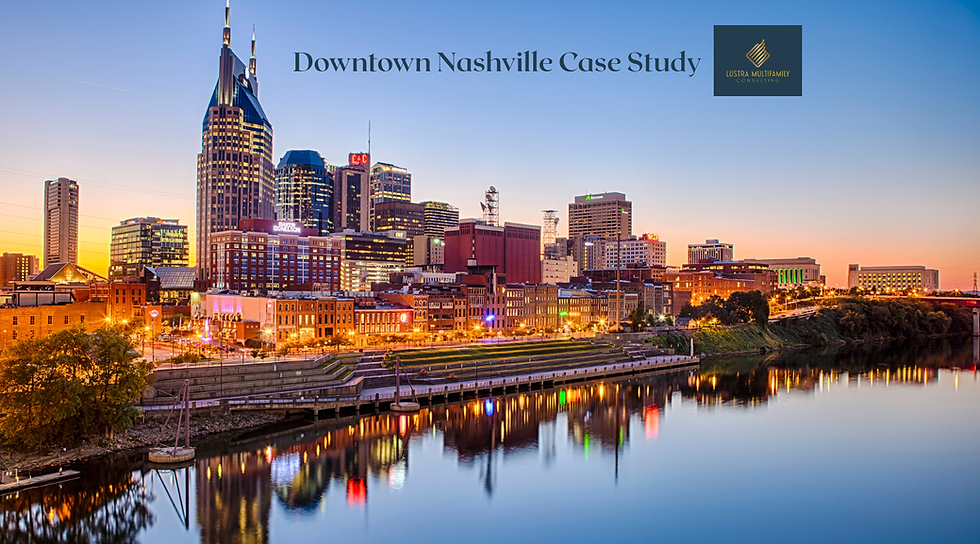
This ownership group had a struggling downtown Nashville community, and the submarket was in full concession war mode. New developments were offering up to three months free, and operators were convinced that matching concessions was the only path to survival.
But that wasn’t the truth, not for this asset, and not for the renter psychology of this specific submarket.
THE PROBLEM
The community wasn’t underperforming because it lacked concessions. It was underperforming because its marketing wasn’t aligned with how Nashville renters actually make decisions.
The existing strategy leaned heavily on:
Generic messaging
Commodity‑style advertising
Traffic‑inflating channels with low conversion
No emotional narrative
No lifestyle positioning
No differentiation from the concession‑heavy competition
The result? Plenty of traffic. Very few leases. The closing ratio was around 3%. Traffic wasn't the issue.
THE STRATEGY
Instead of joining the concession race, we went deeper into the psychology of the Nashville renter. We discovered that their ideal renter wasn’t necessarily driven by discounts alone; they were driven by identity, lifestyle, and a sense of belonging to a community. They wanted to feel connected to the neighborhood, the culture, and the city's rhythm. They wanted authenticity, not gimmicks.
So we rebuilt the marketing strategy around:
Hyper‑local lifestyle storytelling (online, but also tangibly on-site with candid video tours, adding an additional guest suite, and human-centered centralized leasing for a personal touch and customized follow-ups)
Neighborhood‑anchored creative (long-live Broadway Street)
Messaging that spoke to aspirations, not discounts (promoted community events, resident get-togethers, local clubs, walking groups, and lifestyle-rich commentary)
High‑intent channels that matched renter search behavior (paid search was extremely expensive in this urban market. We got hyper-local on social groups and influencers)
A clean, conversion‑driven digital pathway (Top-Priority)
Visuals that helped renters “see themselves” in the community



Comments